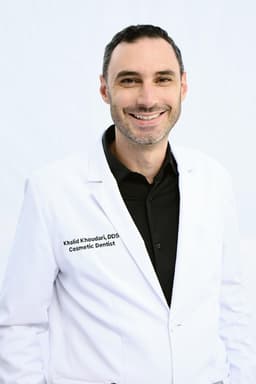
Neuromuscular dentistry measures how your jaw, muscles, and bite work together when TMJ symptoms keep returning. Dr. Khoudari applies that approach at our Newport Beach office, about 20 minutes from Mission Viejo, using CBCT imaging, bite analysis, and conservative treatment plans built around function rather than guesswork.
Mission Viejo is a city of planners. Patients from the Lake Mission Viejo neighborhoods, the Oso Creek corridor, and the Kaleidoscope area arrive with notes, symptom timelines, and screenshots from late-night research sessions. That level of preparation fits neuromuscular dentistry well because this approach asks a bigger question than "Does your jaw click?" It asks how the joint, muscles, teeth, and posture interact every day.
Dr. Khoudari, DDS, uses neuromuscular principles when standard stopgap care has failed. In our 20+ years serving Southern California, we have seen the same pattern repeatedly: a patient receives a generic mouthguard, the jaw still hurts, and nobody explains why. Neuromuscular dentistry closes that gap by measuring the system instead of treating only the symptom that hurts the most.
See whether neuromuscular TMJ care fits your case — schedule your free Newport Beach evaluation →
What Is Neuromuscular Dentistry for TMJ in Mission Viejo?
Neuromuscular dentistry is a method of analyzing jaw function that looks at joint position, muscle strain, bite contact, and movement patterns together. The goal is not only to reduce pain. The goal is to find the jaw position where the muscles relax, the bite closes more evenly, and the joints stop absorbing excess force.
For Mission Viejo patients, that matters because chronic TMJ symptoms rarely come from a single isolated problem. They often involve a chain reaction: clenching overloads the muscles, the bite slides forward, the disc stops moving smoothly, and headaches begin. When we treat the chain instead of one link, relief lasts longer.
The data points are measurable. A first neuromuscular evaluation usually takes 45 to 60 minutes. CBCT imaging captures the joints in under 20 seconds. Most patients starting the correct splint-based plan report improvement within 2 to 4 weeks, while full stabilization takes 3 to 6 months depending on how long the imbalance has been present.
How Is Neuromuscular Dentistry Different From a Standard Bite Check?
A standard bite check looks for obvious interferences, tooth wear, and soreness. Neuromuscular dentistry goes further. Dr. Khoudari evaluates joint range of motion, muscle tenderness, tracking symmetry, wear patterns, and how the bite closes when the jaw is relaxed rather than forced into a strained position.
| Evaluation Step | What We Measure | Why It Matters |
|---|---|---|
| CBCT scan | Joint anatomy and condyle position | Shows whether the joint is inflamed, compressed, or asymmetrical |
| Range-of-motion testing | Opening, deviation, and locking pattern | Identifies disc displacement and movement restriction |
| Bite analysis | Where teeth hit first and hardest | Reveals overload that keeps the muscles firing |
| Muscle exam | Masseter, temporalis, and neck tenderness | Separates joint pain from muscle-dominant TMD |
That distinction matters especially in Mission Viejo, where many patients have already tried a basic night guard from another office. If the appliance was built without functional analysis, it can protect enamel while still leaving the joint compressed and the muscles hyperactive.
Need the terminology clarified first? Read our TMJ vs TMD guide or review the symptom signs that point toward TMJ treatment →
What Happens During a Neuromuscular TMJ Evaluation?
Your first visit begins with a symptom history that focuses on time, trigger, and intensity. Dr. Khoudari wants to know whether the pain starts in the morning, worsens after chewing, travels into the temple, or changes with stress. That timeline often reveals whether clenching, joint compression, or a shifting bite is leading the problem.
- Clinical examination: We measure opening, note joint sounds, and palpate the chewing muscles to find the main pain generators.
- CBCT imaging: A three-dimensional scan shows the joints, condyles, and surrounding structures with far more detail than a standard dental X-ray.
- Bite and movement review: Dr. Khoudari studies how your teeth meet and how the jaw tracks on opening and closing.
- Written plan: You leave with a diagnosis, treatment sequence, and exact cost range rather than a vague "wait and see" answer.
A Mission Viejo patient from the Lake area recently came in after three months of headaches that were being treated as migraines. Her exam showed heavy nighttime clenching, a bite slide, and muscle-dominant TMD. Once we stabilized the bite with a custom splint, the morning headache pattern changed within two weeks and the jaw pain followed.
Get a Functional TMJ Diagnosis
If a basic mouthguard has not fixed the problem, the next step is not guesswork. It is a better workup.
Book Your Neuromuscular TMJ Evaluation →Which Treatments Follow a Neuromuscular TMJ Diagnosis?
Once the diagnosis is clear, treatment is staged. A custom therapeutic splint usually comes first and ranges from $800 to $1,500. Botox for severe clenching ranges from $600 to $1,000 per session. Physical therapy protocols or bite adjustments are added when muscle patterns or deflective contacts keep the jaw unstable.
Neuromuscular dentistry does not mean every patient receives every treatment. It means every treatment is selected because it solves a defined functional problem. A patient with joint inflammation and limited opening needs a different sequence than a patient with masseter hypertrophy and stress-driven clenching.
For Mission Viejo professionals commuting around the 5 and 73 corridors, efficiency matters. Follow-up visits are shorter than the first appointment, often 15 to 20 minutes, and are scheduled around work hours whenever possible. Most patients notice whether the plan is moving the needle within the first month.
Explore our TMJ/TMD treatment page or see what a first TMJ specialist visit looks like from start to finish →
Why Do Mission Viejo Patients Choose Our Newport Beach Office for Neuromuscular TMJ Care?
Mission Viejo's strongest TMJ demand comes from adults in the 45 to 65 age range who want specialist care without being bounced between offices. Residents near Lake Mission Viejo, Oso Creek Trail, and the Kaleidoscope business corridor often tell us the same thing: they want one doctor who can explain the mechanics, the timeline, and the long-term plan in plain language.
Our Newport Beach office at 20072 SW Birch Street, Ste 150, is about 20 minutes from Mission Viejo via the 5 North or the 73 Toll Road. That access is simple enough for evaluation visits and short enough for follow-up care, which is why patients from South County continue north for specialized TMJ work that is not widely available close to home.
Neuromuscular dentistry also aligns with Mission Viejo's research-heavy patient culture. Calibrated diagnostics, written treatment phases, and measurable progress markers build confidence better than broad promises. Call (949) 767-2700 or visit our Newport Beach location page to plan your visit.
Frequently Asked Questions About Neuromuscular Dentistry in Mission Viejo
Is neuromuscular dentistry only for severe TMJ cases?
No. It is useful whenever symptoms keep returning or prior treatment failed because the jaw, muscles, and bite were never analyzed together.
Does a CBCT scan expose me to a long imaging appointment?
No. The scan itself takes under 20 seconds and provides a three-dimensional view that standard dental X-rays cannot match.
Will I always need Botox if neuromuscular care is recommended?
No. Botox is reserved for severe clenching or muscle overload. Many cases improve with splint therapy and bite stabilization alone.
How soon do patients notice improvement?
Most patients notice measurable relief within 2 to 4 weeks after the right appliance and habit plan begin.
Can neuromuscular dentistry help if my migraines start in the jaw?
Yes. When the headache pattern begins with clenching, temple tension, or jaw fatigue, neuromuscular TMJ care often reduces the trigger load.
Is Mission Viejo too far for ongoing follow-up care?
No. Follow-up appointments are brief, and our Newport Beach office is about 20 minutes from Mission Viejo via the 5 or the 73.
Bring the Symptoms. Leave With a Functional Plan.
Mission Viejo patients do best when the diagnosis explains the mechanics. That is exactly what neuromuscular TMJ care is designed to do.
Schedule Your Newport Beach Consultation →Neuromuscular dentistry is not a marketing label. It is a structured way to understand why jaw pain keeps returning and how to stop it with a better diagnosis. Mission Viejo patients who want specifics instead of guesswork tend to do very well with that approach.
Call (949) 767-2700 or book your free TMJ evaluation online. If your bite feels off, your temples ache, or your jaw keeps tightening overnight, Dr. Khoudari will show you what is driving it.