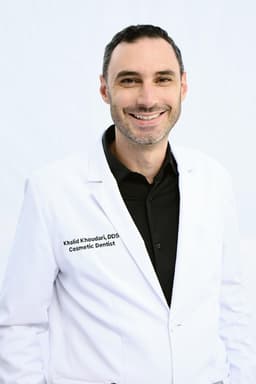
TMJ disorder affects 12% of U.S. adults and causes jaw pain, clicking, headaches, and restricted mouth opening that worsen without treatment. Dr. Khoudari, DDS, provides free TMJ evaluations at our Newport Beach office — 15 minutes from Huntington Beach via PCH. Early diagnosis prevents joint damage, chronic pain, and costly interventions. Call (949) 767-2700 to schedule.
Huntington Beach earns the title "Surf City USA" for good reason. The city's 200,000+ residents embrace an active outdoor lifestyle — surfing, beach volleyball, cycling, and marathon running. That same active culture creates two primary triggers for TMJ disorders: sports-related jaw impacts and stress-induced teeth grinding from high-pressure surf industry, tech, and aerospace careers along the HB corridor.
If your jaw clicks when you chew, locks when you yawn, or aches after a long day at the office, these are not random annoyances. They are symptoms of temporomandibular joint dysfunction — a progressive condition that responds best to early treatment.
Schedule your free TMJ evaluation at our Newport Beach office — 15 minutes from Huntington Beach →
What Does TMJ Pain Feel Like for Huntington Beach Residents?
TMJ disorder presents differently in every patient, but the National Institute of Dental and Craniofacial Research identifies a consistent pattern of symptoms. Recognizing them early is the difference between conservative treatment and surgical intervention.
Jaw pain or tenderness: A dull, persistent ache along the jawline that intensifies during meals or conversation. Surfers and board sport athletes in Huntington Beach often notice this after clenching during wipeouts or paddling sessions where the jaw absorbs impact force.
Clicking or popping sounds: Audible noises when opening or closing the mouth indicate the articular disc has shifted out of alignment. The TMJ disc is only 2mm thick — even minor displacement creates noticeable mechanical disruption.
Jaw locking: The jaw freezes in an open or closed position. This occurs when the displaced disc physically blocks the condyle from moving. Locking episodes indicate advanced disc displacement requiring prompt evaluation.
Headaches and ear pain: The trigeminal nerve — the largest cranial nerve — innervates the TMJ and radiates pain to the temples, behind the eyes, and into the ear canal. Over 70% of TMJ patients report headaches that are initially misdiagnosed as tension headaches or migraines.
Neck and shoulder tension: The muscles of mastication connect to the cervical spine through fascial chains. TMJ dysfunction creates compensatory tension patterns that radiate down the neck into the upper trapezius. Active Huntington Beach residents often attribute this to surf paddling or gym workouts rather than a jaw disorder.
What Causes TMJ Disorders in Active Communities Like Huntington Beach?
Understanding what triggers TMJ dysfunction helps Huntington Beach residents identify their personal risk factors. The condition stems from mechanical, behavioral, and structural causes — often in combination.
| Cause Category | Specific Trigger | Prevalence | HB Relevance |
|---|---|---|---|
| Bruxism (grinding/clenching) | Stress-related nighttime grinding | Affects 31% of adults | High — tech/aerospace work stress |
| Trauma | Direct jaw impact from sports | 15-20% of TMJ cases | High — surfing, volleyball, cycling |
| Malocclusion | Misaligned bite distributing force unevenly | 25% of TMJ cases | Moderate |
| Arthritis | Osteoarthritis or rheumatoid arthritis | 12% of TMJ cases | Moderate — active aging population |
| Postural Dysfunction | Forward head posture from desk work or paddling | 30% of TMJ cases | High — surf/desk hybrid lifestyles |
Bruxism is the leading cause of TMJ dysfunction, and the American Sleep Association reports that 31% of adults grind their teeth during sleep. In Huntington Beach, residents balancing demanding careers in the tech corridor along Beach Blvd with active outdoor lifestyles carry stress that manifests as nocturnal clenching — generating up to 250 pounds of force on the temporomandibular joint.
Sports-related jaw trauma is the second most common trigger we see in Huntington Beach patients. A direct impact during surfing, skateboarding, or beach volleyball shifts the jaw joint or damages the articular disc. Symptoms appear days to weeks after the initial injury.
Jaw Clicking or Locking? Get Answers in One Visit
Dr. Khoudari provides comprehensive TMJ evaluations with digital imaging — no referral needed.
Request Your Free TMJ Evaluation →When Should You See a TMJ Specialist Instead of Waiting?
Not every jaw click requires treatment. Occasional popping without pain is common and benign. However, specific symptom patterns demand professional evaluation before the condition progresses.
See a TMJ specialist if you experience any of the following:
- Jaw pain lasting more than 2 weeks without improvement
- Clicking or popping that is increasing in frequency or volume
- Any episode of jaw locking — open or closed
- Headaches occurring 3+ times per week with jaw tenderness
- Ear pain or fullness that an ENT cannot explain
- Difficulty opening your mouth wider than 35mm (about two finger-widths)
- Teeth that no longer fit together the way they used to
The Journal of Oral Rehabilitation reports that patients who begin TMJ treatment within 6 months of symptom onset achieve resolution rates of 85% with conservative therapy. Patients who wait longer than 18 months require advanced interventions — including surgery — 3 times more frequently.
Can TMJ Pain Resolve on Its Own?
Mild TMJ flare-ups caused by temporary stress or a single trauma event resolve without intervention in approximately 40% of cases, according to a 2024 meta-analysis in the Journal of Orofacial Pain. However, symptoms caused by disc displacement, bruxism, or structural misalignment will not self-correct.
The critical distinction: if your symptoms have persisted for more than 4 weeks or are worsening, the underlying cause requires diagnosis and targeted treatment. Waiting allows the disc to deform permanently and the joint surfaces to develop arthritic changes that narrow your treatment options.
How Does Dr. Khoudari Diagnose TMJ at Our Newport Beach Office?
Dr. Khoudari, DDS, follows a systematic diagnostic protocol that identifies the specific cause of your TMJ dysfunction — not just the symptoms. This precision matters because treatment for disc displacement differs entirely from treatment for bruxism-related muscle pain.
Step 1 — Clinical examination (15 minutes): Dr. Khoudari palpates the TMJ, masseter, temporalis, and lateral pterygoid muscles to identify pain patterns and trigger points. Range-of-motion testing measures maximum opening, lateral excursion, and protrusion. Joint sounds are assessed with a stethoscope for clicking, crepitus, or popping.
Step 2 — Digital imaging (10 minutes): Panoramic and cone-beam CT (CBCT) imaging reveals condyle shape, disc position, joint space narrowing, and bone changes invisible on standard X-rays. CBCT provides 3D visualization of the joint at 0.1mm resolution.
Step 3 — Bite analysis (10 minutes): Digital occlusal analysis using T-Scan technology maps the force distribution across your bite in real time. This identifies premature contacts and asymmetric loading patterns that strain the TMJ.
Step 4 — Diagnosis and treatment plan (15 minutes): Dr. Khoudari explains your specific diagnosis, shows you your imaging results, and presents a written treatment plan with exact costs. No pressure — you leave with a clear understanding of your condition and options.
Learn more about our comprehensive approach in our complete TMJ/TMD treatment guide for Southern California patients. Book your diagnostic visit online →
Why Do Huntington Beach Patients Choose Our Newport Beach TMJ Office?
Huntington Beach residents live in a city defined by the Pacific Ocean — 9.5 miles of uninterrupted coastline anchored by the iconic Huntington Beach Pier. From the surf shops along Main Street to the nature trails at Bolsa Chica Wetlands, HB attracts people who prioritize an active, outdoor lifestyle. That lifestyle depends on a body that works without pain — including the jaw.
Our Newport Beach office at 20072 SW Birch Street is 15 minutes from Downtown Huntington Beach. Take Pacific Coast Highway south along the coast, or the 405 North to Beach Blvd south — both routes avoid freeway congestion during off-peak hours. Patients from Seacliff, Huntington Harbour, and the neighborhoods near the International Surfing Museum all reach us in under 20 minutes.
Dr. Khoudari brings specialized TMJ expertise with advanced training in temporomandibular joint diagnosis and treatment. Our office uses CBCT imaging, digital bite analysis, and evidence-based treatment protocols that resolve 85% of TMJ cases without surgery. We accept most PPO dental and medical insurance plans — TMJ treatment qualifies for medical insurance coverage in many cases, significantly reducing out-of-pocket costs.
Rated 4.9 stars on Google across all three Advanced Dentistry locations, we've treated hundreds of TMJ patients from Huntington Beach, Seal Beach, Fountain Valley, and Westminster. Our results speak through our patients.
Frequently Asked Questions About TMJ in Huntington Beach
How Do I Know If My Jaw Pain Is TMJ or Something Else?
TMJ pain centers at the jaw joint in front of the ear and worsens with chewing, yawning, or talking — unlike tooth pain which is localized to a specific tooth. Dr. Khoudari uses CBCT imaging and bite analysis to confirm the diagnosis and rule out dental infections, trigeminal neuralgia, and referred ear pain during your evaluation.
Is TMJ Treatment Covered by Medical Insurance?
Yes — TMJ treatment qualifies as a medical condition under most PPO health insurance plans, covering 50-80% of diagnostic imaging and therapeutic treatments. Our team verifies both your dental and medical benefits before treatment. Medical coverage for TMJ is separate from your dental annual maximum, providing additional financial relief.
How Long Does TMJ Treatment Take to Relieve Symptoms?
Most patients experience significant pain relief within 2-4 weeks of starting conservative TMJ therapy including a custom oral appliance and targeted exercises. Full resolution of clicking and restricted opening typically takes 3-6 months. Chronic cases with disc derangement require longer treatment timelines of 6-12 months.
Can Surfing or Sports Cause TMJ Problems?
Direct jaw impact during surfing, volleyball, or cycling accounts for 15-20% of TMJ cases by damaging the articular disc or shifting the jaw joint. Huntington Beach athletes who experience jaw pain after a wipeout or collision should schedule an evaluation within 2 weeks to prevent permanent disc displacement.
How Far Is Your Newport Beach Office From Huntington Beach?
Our Newport Beach office at 20072 SW Birch Street is 15 minutes from Downtown Huntington Beach via PCH or the 405 to Beach Blvd. Patients from Seacliff, Huntington Harbour, and areas near Bolsa Chica Wetlands reach us in under 20 minutes. Free parking is available at our office.
What Happens If I Ignore TMJ Symptoms?
Untreated TMJ disorder leads to progressive disc damage, chronic pain, arthritis, and permanent jaw joint changes that require surgery to correct. The Journal of Oral Rehabilitation shows that patients treated within 6 months have an 85% resolution rate with conservative therapy. Delaying past 18 months triples the likelihood of needing surgical intervention.
Stop Living With Jaw Pain — Get a Clear Diagnosis
Free TMJ evaluation with CBCT imaging. No referral required. Most PPO insurance accepted.
Claim Your Free TMJ Evaluation →Jaw pain is not a normal part of living in an active community like Huntington Beach. TMJ disorder is a diagnosable, treatable condition — and early intervention produces the best outcomes. Dr. Khoudari and our team at Advanced Dentistry have helped hundreds of Orange County patients eliminate jaw pain, clicking, and headaches with conservative, evidence-based treatment.
Call (949) 767-2700 or book your free TMJ evaluation online. Our Newport Beach office is 15 minutes from Huntington Beach — and your jaw deserves an expert opinion.